Monday, 9 May 2016

647. Dentist will treat the elderly at home

The initiative was the idea that anyone who is bedridden with little physical mobility or dependent on others, you need a good oral hygiene to achieve better health. It was precisely this thought of Sonia Santos, medical dentist working in the areas of Peso da Régua and Vila Real, Tras-os-Montes. The project is unique in the country and, for now, the dentist makes consultations at home only in these areas and that type of users.For years, consultations were free. About three years ago, Sonia began to charge the same as a query in clinics where she works: 80 euros. But journeys at home are still not charged. A small case that fits in a kind of air bag is brought home to the users. These people who are bedridden, it is easier to have someone to care for them for basic care than oral hygiene because it is always a more personal area. These people start to have plaque, tartar, cavities. They are suffering. Stop eating. To be a full physical health, we must address the oral health, explains Sonia Santos.
Consultation at home is almost equal to what is done at the clinic. Three years ago we do all kinds of home service: facelifts, cleanings, extractions. Only place implants and advanced surgery is that it is impossible to do at home, said.There were two cases that marked this medical dentist. The first patient who attended was morbidly obese and was bedridden. I could not do anything when I got there. It was treated and only past eight days is to gather all that was possible and went to her house. Shocked me because there are people who die with the wrong infection and she was in that situation, recalls Sonia Santos. The other case was a boy of nine, paraplegic, who made a tooth extraction. It went well, he says.According to the doctor, are the users themselves and the families of those who call for it to be done the treatment at home. They do not see it as a luxury, but as a help, since many can not afford to take them to the office nearest dentistry.
Ana Sofia Coelho
 

Friday, 15 April 2016

645. How to whiten teeth with Sodium Bicarbonate

Want whiter teeth without having to spend money on expensive treatments and products? Luckily, there is a common homemade product that works wonders in tooth whitening: Sodium bicarbonate! Sodium bicarbonate is a mild abrasive that effectively removes stains on teeth caused by tea, coffee, cigarettes and other things. Learn how to do this.
Method 1: Basic
1 - Mix baking soda with water. In a small cup, mix half a teaspoon of baking soda with half a teaspoon of tea water. Mix to form a paste. Dip your toothbrush in the cup to cover the bristles with paste of
Sodium bicarbonate.
Alternatively, you can put the brush wet teeth directly in
Sodium bicarbonate and powder will hold the bristles. However, the taste of baking will be very strong if you use this method.
2 - Brush your teeth one to two minutes. Brush your teeth as you normally would, but focus on passing the brush at all openings and recesses. Not brush the teeth for more than two minutes, since the sodium bicarbonate is a mild abrasive and can begin to corrode the enamel of the teeth.
Be aware that the taste of
Sodium bicarbonate is not particularly pleasant!
3 - Rinse. Spit
Sodium bicarbonate and rinse your mouth with water or mouthwash. Wash your toothbrush too.
4 - Repeat every other day. You should repeat the process of brushing the teeth with sodium bicarbonate in alternating days one to two weeks. You will notice a slight difference between the color of your teeth after a few days and a substantial difference after two weeks.
After two weeks brushing the teeth with sodium bicarbonate, on alternate days, you decrease the frequency to only once or twice a week. This is because the abrasive properties of
Sodium bicarbonate can damage the enamel of your teeth if the bicarbonate is used very often.
Be aware that brushing your teeth with
Sodium bicarbonate should not replace brushing with toothpaste. The toothpaste contains fluoride, which is important to strengthen teeth and prevent cavities.
Method 2: Alternative
1 - Mix the Sodium bicarbonate with hydrogen peroxide. Hydrogen peroxide is another great product we have at home and that can be used to whiten your teeth effectively. Just mix half a teaspoon of hydrogen peroxide tea with a teaspoon of Sodium bicarbonate to form a paste that resembles the consistency of toothpaste. Brush your teeth with this mixture, then leave it on the teeth for a minute or two. Rinse with water or mouthwash.The hydrogen peroxide can be found in most drug and is usually sold in opaque bottles, to prevent the solution react with the light. Be sure to buy a solution of 10 volumes, which is safe for oral use.Hydrogen peroxide is also an effective anti-bacterial mouthwash.2 - Mix the Sodium bicarbonate with lemon juice. The bicarbonate can be mixed with fresh lemon juice, as citric acid is an effective bleaching agent. Just mix half a teaspoon of Sodium bicarbonate with half teaspoon of fresh lemon juice. Brush this mixture on your teeth using a toothbrush and leave acting for about a minute before brushing well.Be aware that most dentists do not recommend this method, since citric acid is corrosive and will damage your teeth.
3 - Mix Sodium bicarbonate with toothpaste. You can mix some Sodium bicarbonate with your common toothpaste to have bleach effects of sodium bicarbonate, combined with strengthening properties and protection of existing fluoride in toothpaste. Just put the normal amount of toothpaste on your toothbrush, sprinkle a little Sodium bicarbonate on top, then brush normally.Tips:Make sure you do not brush your gums, as this can cause a burning sensation and bleeding.Using an electric toothbrush will help you brush their teeth faster and more effectively.After brushing your teeth, brush your tongue. Bad breath only has to do with the teeth when they are with pieces of food and board. The main cause of bad breath is bacteria growing in the gums. Try to lightly brush the entire inner surface of your mouth (except the throat) after swishing the rinse, just before rinsing.
alerts:
Sodium bicarbonate can dissolve orthodontic glue. Do not use this method if you use braces or a retainer.
Do not use this method often, as abrasion can permanently damage the enamel of your teeth. There are certain special brands of toothpaste (usually for smokers) that contains much softer abrasive than
Sodium bicarbonate. They can be used daily without risk to the health of your teeth and help remove not only the stains caused by smoking but also those caused by the intake of coffee, tea and wine.
Do not brush your teeth too hard, as this may damage the enamel of your teeth, causing hypersensitivity.

Tuesday, 29 March 2016

644. Half of Portuguese go to the dentist less than once per year

According to data released at the Congress of the Dental Association, 8.3% of respondents has never been to the dentist and 21.2% say they will only when you have a dental problem, urgency or pain. Of the more than a thousand respondents, 20.9% reported having reduced the number of visits to the dentist in the last year, with the monetary issue to be the main reason evoked not to go.
Are less than a quarter the Portuguese indicating the dentist two or more times a year, while about half (48.8%) of the Portuguese claims hold a dental checkup less than once a year. Of the respondents, 51.5% believe that the National Health Service (SNS in portuguese) does not provide dental services and only 10.2% have resorted to public facilities when they need oral health services.
Commenting on these results, the president of the Dental Association found that Portugal needs to work on access to the Portuguese dentist, creating mechanisms to help people to be able to treat oral health. There in Portugal possibility of the general population to an adequate health monitoring. It has previously had an accessibility problem because the SNS never responded to this area. Since there is no mechanism to reimburse them or help the Portuguese to regular consultation, the Portuguese pay out of your pocket these consultations. And with the economic crisis is affected the ability of the population had access to the dentist, summarized Monteiro da Silva.The conclusions of the first National Oral Health Barometer also show that 70% of Portuguese lack of natural teeth, and more than 20% lack of at least 10 teeth and 7% of the Portuguese population has no natural tooth. The barometer also reveals that 56.1% of Portuguese who lack natural teeth have nothing to replace them. Only 7.7% substitutes have fixed teeth, while the remaining 36.2% have prosthesis. Half of the respondents admit that ever felt difficulty eating and / or drinking due to problems in the mouth and teeth and 18% confess that ever felt embarrassed because of the appearance of their teeth, realize ...
On the habits of oral health, the study reveals that the Portuguese meet the basic but few have more sophisticated ways. If 97.3% claims to have a habit of brushing teeth, however, 54.4% use no elixir and 76.2% admit not to use dental floss. Of brushing teeth, 72.7% do it two or more times per day, specifies the document.
The Barometer results also indicate that women have hygiene and cleaning rates superior to men. The lack of natural teeth, with the exception of wisdom teeth, is correlated with the habit of brushing your teeth, to the extent that the fewer natural teeth has who responded, the lower their hygiene habits, reads the statement with conclusions.
The survey also reveals that the Portuguese (93.5%) are satisfied or very satisfetios with your dentist. To emphasize that 63.7% of the Portuguese never changed their dentist. The main loyalty factors are confidence in the dentist, the quality services and habituation, said the document also states that the majority of Portuguese (64.5%) clarifies doubts oral health with your dentist to the detriment of other media such as the internet.
The first national barometer of oral health was made in 1102 based on in-person interviews, and statistical validity.
* * *
It is very urgent that a national strategy be defined in the oral health and dentistry. While organizations linked to oral health innocuously persist in wanting to work without cooperate collectively with all other entities, the oral health of the Portuguese will be degraded and are always the lower social classes who pay the mistakes of leaders unable to give the necessary answers the population.
For when a true union of wills between the doctors of oral medicine, oral hygienists and dentists, both public and private sector, to address the lack of oral health strategy in our country?
Just so much hypocrisy: while some sectors of dentistry are pleased with some largesse given by the political power, the oral health services continue to be denied to the majority of the population.


Monday, 28 March 2016

643. COURT OF AUDITORS: Death of dental public sector in Portugal

The Court dictated the death of
dentistry public sector in Portugal
For when a rejection reaction on the part of the Medical dentists and the Minister of Health to how it is treated the Faculty of Dental Medicine of Lisbon? How many doctors dentists Portuguese were formed in that institution? How many members of the Court have already been treated by dentists trained in that institution? Attacking those who provide health care with social nature tells all about who carried out the audit; surely unprecedented, extremely shameful and that even the most developed in the world occur ...
* * *
Clinic External Faculty of Dental Medicine of Lisbon will close on 31 October, following irregularities found by an audit of the Court (TC). The announcement was made Saturday by the Director of the School of Dental Medicine, João Aquino Marques, after a CT scan of the report indicates that the existence of that unit is not provided for in the statutes of college and has no license from the Regional Health Administration of Lisbon and Vale do Tejo or any other entity to operate.
Although the Court considers not to be in question the quality of services and recognizing the social role given to disadvantaged sectors of the population, it stresses that the clinic should observe the rules and best practices applicable to public bodies and activities pursued. For João Aquino Marques, External Clinic is part of the organizational structure of the Faculty, not being thus a private drive that requires licensing by the health regulator and has worked over the last 10 years as an extension of the university service, shared opinion by the Secretary-coordinator, Dário Vilela.
The institutions of funding and, at the time, it seemed a good idea to open the school to the general population. The external or integrated clinic is a hospital service with doctors, depends on the college uses its facilities and is a source of revenue, said Aquino Marques. Dário Vilela stressed that the clinic is responsible for about 20,000 annual consultations and that its closure will put an end to the single query in the public sector for adults with special needs.
Taking into account the restrictions adopted by the Government to the employees by public contracting, João Aquino Marques considered that does not have great alternatives unless the closure of the clinic, since it can not make contracts for the provision of services or of covenant. They ask us to be creative. We do not want to close the outer query, but legal alternatives are to create a private clinic, with the opening of a competition which private clinics can compete. This does not concern us, since we want to follow our teaching philosophy, he explained.
According to him, the state budget for the college is around 1.8 million euros per year and the salaries of teachers and staff come to 3.8 million euros. When the Court of Auditors says that the clinic does not prove that we are self-sufficient, the proof is that never have paid from our pockets wages. And we spend 400,000 euros in clinical material. We must do our damnedest to this. We made this illegality that the TC points and are penalized for it, retorted.
According to the same official, the external clinic has been operating for about ten years, employs 60 people, including 42 dentists, and serves about 20,000 people, accounting for a 50% increase to 45 000 consultations for college .do amount paid in the query by patients, 40% is for dentists, 60% for college.

Thursday, 10 March 2016

642. There are 30 municipalities in Portugal without dentists registered

More than 150,000 people in 30 Portuguese municipalities are without dentist, according to official figures from the Dental Association (OMD), who admits a distribution of accumulated too professional in coastal areas.
The Order of the numbers, the Lusa agency had access show that in 30 municipalities (10% of total) there is no dentist registered, although the president admits that there may be professionals from neighboring counties to give some queries in these locations.
Municipalities are small, relatively unpopulated, mainly from the countryside. These are regions that are in a growing desertification and have difficulty in attracting dentists and municipalities with a very low population, specified Orlando Monteiro da Silva speaking to Lusa.
The president of OMD argues that the state can and should create incentive mechanisms to attract dentists to settle in areas with little or no coverage, noting that the municipalities also have their role.
Alcoutim, Aljustrel, Alvito, Arraiolos, Barrancos, Chamusca, Corvo (Azores), Figueiró dos Vinhos, Freixo de Espada a Cinta, Gavião, Marvão, Nisa, Oleiros, Ourique, Penamacor, Viana do Alentejo and Vila Velha de Ródão are some of the municipalities without registered dentists.
In these 30 municipalities, the average resident population of 4,864 people, according to the Order of the data relating to 2014.

Wednesday, 24 February 2016

641. More than 173,000 people receive dental checks since January

More than 173,000 people have received dental checks since January, with the largest share of beneficiaries to be the children of 7 to 13 years, according to official figures from the Dental Association. In the first five months of the year, 173 259 people received dental checks, with a total utilization rate of around 65%, but ranging from 24% to 15 year olds to 85% in patients with HIV / AIDS.
The main beneficiaries are children aged 7, 10 and 13 years in public schools, which already received more than 120,000 checks to use in dental treatment in private clinics. Since the program began in 2008, about 1.9 million users had access to dental checks, with which they were performed more than 6.5 million treatments.
This National Program for Promotion of Oral Health covers children and young people who attend public schools at 7, 10, 13 and 15 years of age and followed pregnant women in public services, seniors who receive the solidarity supplement and people with HIV / AIDS. Since the program began, the number of beneficiaries has been steadily increasing, surpassing the 413,000 last year, with more than 633,000 checks issued and 408,000 actually used.
According to the president of the Dental Association, the program data also show that the severity of the lesions treated has been steadily decreasing, which meets the objectives. About 60% of interventions correspond to preventive procedures such as application of sealants (protecting the cracks of the teeth against tooth decay), with the incidence of cavities to provide significant reductions in children, "the main target" program.
The Dental Association argues, however, that the program be extended to diabetics, remembering that it is a group with additional risk for oral health problems. For the president, Orlando Monteiro da Silva, in the current economic situation of the country should be considered to extend the program to additional risk groups such as diabetics. For this, da Silva Monteiro stresses that an increase of the program's budget, even remembering that there are about one million diabetic diagnosed in the country.
Although the issue of the funds needed to extend dental checks be a decision of the Ministry of Health, the president believes that it is an investment that allows for cost rationalization. There is a huge relationship between diabetes and oral health. Diabetes needs to be controlled to have a good oral health and vice versa. good control of oral health, particularly of the gums and the bone is necessary, so that diabetes is not exacerbated, he told the Lusa news agency.
Recently, the Health Regulatory Authority questioned the universality and equity in access to dental checks, noting that left out children who attend private schools and pregnant not followed in public services. At present there are 3305 dentists to collaborate with the program, which reaches more than 5,500 clinics and offices across the country.
PÚBLICO     

640. the Dental Association's president awarded by AMERICAN DENTAL ASSOCIATION

Orlando Monteiro da Silva, president of the Dental Association (OMD), was elected an honorary member of the American Dental Association (ADA), one of the most respected medical organizations Dentists worldwide.
For the first time, a Portuguese elected honorary member of the ADA. This distinction is awarded to personalities who have contributed in an exceptional way to the advancement of dentistry and globally to promote oral health. In addition to the election as an honorary member of the ADA, the Chairman of the Medical Association was also the first Portuguese to be elected president of the FDI (World Dental Federation).
The delivery of the award will take place at the meeting of the "House of Delegates," the ADA, in October, during the association's annual conference, which takes place in San Antonio, Texas.

Thursday, 14 January 2016

638. ORAL CANCER SCREENING: Claim your rights

Each user of the National Health Service (SNS in Portuguese) shall, from now entitled to two checks dentist annually for diagnosis of oral cancer and the other two for biopsy. According to a rule of the Directorate General of Health, this extension of the National Program of Oral Health Promotion aims to increase the survival of oral cancer after diagnosis of the disease.
It is set to target population persons belonging to risk groups (male smokers, with more than 40 years and alcohol consumption) and patients with lesions in the oral cavity and with complaints of pain, color changes or the surface of the oral mucosa. The value of each check-diagnosis is 15 euros and each check-biopsy 50 euros, each user can receive annually two checks of each.
The Order of Dentists have estimated that are now held annually about five thousand biopsies to oral cancer. The intervention will always get the family doctor or by screening the high risk of users or clinical diagnosis of potentially malignant lesions in the mouth.
The existence of a suspicious lesion should always be subject to differential diagnosis, being sent by the computer system of health centers a check-diagnosis which can be used in a medical dentist adhering to the program. In the case of the dentist or Stomatological consider necessary to perform a biopsy should perform the collection of the product and sent to a reference laboratory using then a check-biopsy.
When a tumor is detected, the laboratory reports, by a computerized system, the Portuguese Institute of Oncology of the respective area, which should make an appointment urgently. The program involved 240 dentists, a network that aims to geographically cover the whole country.

Tuesday, 22 December 2015

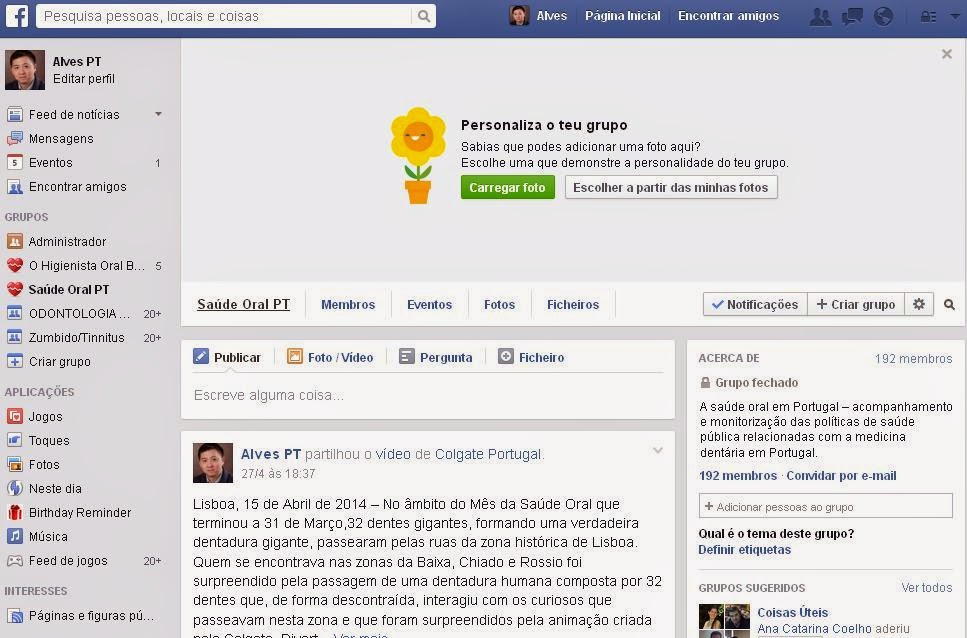
637. Oral Health PORTUGAL

Group on FaceBook
monitoring of oral health in Portugal
* * *
https://www.facebook.com/groups/376006582519771/

636. Thirty-two teeth invade the streets of Lisbon

The passage of the human denture through the streets of Lisbon coincided with the action of mobile office Colgate, which provided hundreds of check-ups free routine to the population between 12 and 16 March. Inserted in the 15th edition of Oral Health Month Colgate, Lisbon, April 15, 2014 - As part of Oral Health Month ended March 31, 32 giant teeth, forming a true giant teeth, strolled through the streets of historic Lisbon. Who was in the areas of Baixa Chiado and Rossio he was surprised by the passage of a human dentition consists of 32 teeth, in a relaxed way, interacted with the curious who roamed this area and were surprised by the animation created by Colgate.Fun, teeth interacted with who toured the area, approaching people to reinforce the importance of good oral hygiene and reminding them that oral health can be viewed in a cheerful and relaxed.
this action was a great way to draw attention to the importance of hygiene and careful oral health in a didactic way, very funny and original. Here's the funny video of human teeth Colgate in action:

Thursday, 3 December 2015

635. Oral health program: evolution, instruments and results

http://repositorium.sdum.uminho.pt/bitstream/1822/22743/1/TESE%20FORMATO%20DIGITAL%20CORRIGIDA.pdf
The state of oral health in children and young people is particularly worrying for the acquired knowledge that caries and periodontal diseases, if properly prevented or treated early, are of a high vulnerability, with reduced economic costs and gains on relevant health. Since 1985, the General Directorate of Health has an ongoing National Programme for the Promotion of Oral Health. This program of oral health in the National Health Service (NHS), began with the promotion of oral health in schools, and later extended to preventive and curative measures with the entry of Oral Hygienists (HO) and contracting with service private dentistry. In 2008, this contractual model has been revised emerging dentist check. The study aims to contribute to the understanding of the evolution of oral health program, their instruments and their latest results. In the empirical study, we analyzed data resulted from information compilation of the Oral Health Program for Children and Youth and screenings conducted at school. The study intends to reflect on the benefits / costs of a model that favors the traces of dental caries, as a measure of screening versus a universal subsidy model which enables access to all children. Hiring Oral Hygienists may have capital gains not only in the short term through the screening of children to assign dentist check, but also long-term with the systematic implementation of measures to promote oral health. In the sample it was found that only about 45.5% of children at age 7, the free teeth have cavities. The study data reveal a membership of only half of the children to a totally free, with 24.7% of children who actually had oral health needs did not use dental check. However, virtually all children using the check complete their treatment plan. The exception that occurs at age 10, related to the eruption of the premolars, suggests a review of the age cohorts assignment dentist check. With application of screening a universe of 237 children with an average rate of 40.7% caries free, it would be possible to reduce costs in 5700 euros. The economic analysis of the oral health sector can make an important contribution in decision-making in this health sector.

Tuesday, 24 November 2015

634. March: Month of oral health

Learn more about the month of oral health

633. Which the dentist ratio: inhabitant recommended by the WHO?

I believe that all dentists should have ever hearing the phrase WHO recommends a ratio of one dentist for every 1,500 inhabitants. But what did you mean by that? That the ratio of 1: 9,000 is bad, then the ratio of 1: 167 is good? It makes little sense.
Paulo Capel Narvai wrote an article for the Journal's website saying that this data would be a legend. A kind of hoax that had begun even before the popularization of the Internet. He says:
It is not enough to combat the current health manpower training policy - there including dental human resources - the boring quote from the World Health Organization recommends one dentist to 1,500 people. (There are variations as 1 / 1,000 and 1 / 2,000). There are at least two errors in that: firstly, WHO does not recommend anything. At some point someone must have misread somewhere mistakenly cited the WHO and, since then, there has been a mechanical and uncritical repetition of this proportion. I never met the bibliographic reference in articles that mention such proportion. In WHO documents, to which I had access, I never read anything about it. Until some researchers uncover the mystery, it can be concluded that it is pure legend.
I confess that for a long time am not silent, looking for the origins of the legend, as found publications until 1979 with this information. Until you hit me the idea to look for where it started (or not): the WHO itself.
I found a statement from the organization that explains the whole thing:
The World Health Organization (WHO) and the Pan American Health Organization (PAHO) does not recommend or establish optimal rates of number of beds per capita to be followed and enforced by its member countries. Nor define and recommend the desirable number of doctors, nurses and dentists per capita. There is also guidance on the optimal duration of medical appointments or a desirable number of patients seen per hour. Emphasis added.
So how it happened?
In the distant year 1972 took place the III Special Meeting of Health Ministers of the Americas, which resulted in Health Ten-Year Plan for the Americas. The assembled ministers agreed the goal of achieving 8 doctors, 2 dentists, 4.5 nurses and 14.5 nursing auxiliaries per 10,000 inhabitants. Only that. 
The document is the result of a PAHO-WHO event, but is not an official resolution of the organization, which would as dentists should exist for every so many thousand inhabitants.
Even because in 1972 the reality was different, right? Right here a Vitor Pinto Article 1983 does not let me lie.
    

Monday, 16 November 2015

632. Dentistas do Bem come to the North Interior to treat children and young people in need

The Dentistas do Bem have reached the north of Portugal being inside the village of Mogadouro the first town in this region to receive this service provided by volunteer doctors dentists will conduct dental appointments children and needy youngsters.
It is important to reach the interior of the country. Had failed to even launch the project in the Northern Interior and so Mogadouro is first settlement of this area to welcome our initiative, he told Lusa Carla Grace, representative of the Turma do Bem.
The Turma do Bem is a Non Governmental Organization (NGO), whose main project is the Dentist Well, want to start the year 2014 spread north of smiles south of Portugal, and chose Mogadouro to help decentralize the project so far I had not yet arrived in the districts of Bragança, Vila Real and Guarda.